The Ghost Kitchen of Pop Music: How Secret Producer Crews Are Cooking Up Every Hit You Love
You know the song. You've streamed it a few hundred times, maybe added it to three different playlists. You know every lyric, every drop, every little sonic quirk that makes it feel like it was made specifically for you. But ask yourself: do you know who actually built it?
Not the artist. Not the featured act. The people in the room before any of that — the ones who sketched the sonic blueprint, laid the drums, sculpted the bass, and handed the whole thing off like a finished canvas waiting for someone to sign it.
Chances are, you don't. And that's exactly how the system wants it.
The Kitchen Nobody Sees
Think of today's hit factory like a high-end restaurant. The celebrity chef gets the Michelin star. Their face goes on the menu. But back in the kitchen, there's an entire crew — line cooks, sous chefs, prep staff — running the actual operation. In music, those are the producers. And increasingly, they don't work alone.
Over the past decade, production has quietly shifted from a solo craft to a collective sport. Crews like Stargate, Sounwave's extended network, and the HNDRXX camp around Future have functioned less like individual hitmakers and more like full-blown sonic laboratories. More recently, newer collectives — many operating out of Atlanta, LA, and increasingly out of London and Toronto — have built entire sonic identities that stretch across multiple artists and genres without ever breaking into public consciousness.
These aren't just guys sharing a studio. They're developing shared sound palettes, passing stems back and forth across time zones, and essentially engineering the emotional texture of what ends up on the Hot 100.
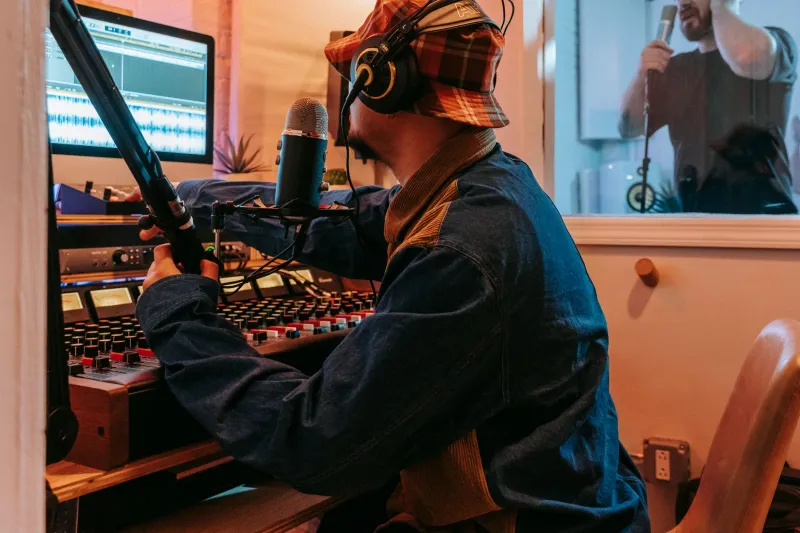
"We'll start a session in Atlanta at noon and by the time we're done, someone in London has already added something to it," one producer affiliated with a major collective told us, speaking on condition of anonymity. "The final product is genuinely a group effort. But when it comes out, there's one name on the front."
The Credit Problem
Here's where it gets complicated. Crediting in the music industry is notoriously messy, and production collectives sit in a particularly awkward spot. When five producers contribute to a single track, the label and artist's management often have strong opinions about how many names appear on the official release — and those opinions usually favor fewer.
Part of this is practical. Streaming metadata is a disaster. Credits get stripped in transit, misattributed in databases, or simply lost when a track gets uploaded in a hurry. But part of it is deliberate. The artist's brand is the product being sold. Every additional name in the credits is, from a marketing standpoint, a dilution.
"Labels talk about 'clutter' when it comes to credits," said one A&R consultant who has worked with multiple major imprints. "Their whole thing is keeping the story clean. One artist, one hit, one narrative. The producers are part of the infrastructure, not the story."
The result is that some of the most sonically influential people in pop music are essentially invisible. They collect their checks — often substantial ones, if they've negotiated well — and watch their work go out into the world under someone else's name.
The Sonic Fingerprint Problem
There's a bigger issue lurking underneath all of this, and it's one that touches on something fans are starting to feel even if they can't name it: when a small cluster of producers is responsible for a huge percentage of charting music, everything starts to sound the same.
It's not a conspiracy. It's just math. If three collectives are producing for 40% of the artists on any given Hot 100, their shared aesthetic preferences — the way they EQ a vocal, the tempo ranges they gravitate toward, the specific synth patches they keep coming back to — become the de facto sound of mainstream music.
A few years back, listeners started noticing that a lot of big pop records had this particular shimmery, almost crystalline quality to the production. That wasn't a coincidence. It was a handful of producers whose sound had become so commercially validated that everyone — labels, managers, artists — kept going back to the same well.
"When something works on the charts, the industry doesn't innovate — it replicates," said one independent music critic who covers production trends. "And when the replication is happening at the collective level, the homogenization is that much faster."
Why Artists Play Along
It'd be easy to frame this as producers getting exploited, but the reality is messier. Many artists are entirely comfortable — even enthusiastic — about the arrangement. Having a top-tier collective in your corner is a status symbol. It's a shortcut to a polished, radio-ready sound that would take years to develop independently.
And the collectives themselves aren't exactly suffering. The best ones have figured out how to build leverage through volume. If you're responsible for three tracks on an album, you have more negotiating power than if you just did one. Some collectives have essentially become shadow labels — managing their own rosters, signing their own deals, and building equity in ways that go far beyond a single production fee.
But the cultural cost is real. When the people shaping the sound of a generation go uncredited, something gets lost. The history gets written incompletely. Future music scholars, fans trying to understand how a particular era sounded, even the artists themselves — they're all working from a partial record.
The Slow Push for Transparency
There are signs that the conversation is shifting. The Recording Academy has made noise about improving production credits in Grammy submissions. Platforms like Genius and AllMusic have invested in more thorough metadata. A handful of high-profile producers have started using their social media presence to publicly claim their work — posting in-studio clips, tagging their contributions, building their own audiences independent of the artists they work with.
Some newer artists, particularly those who came up through the internet and have a more democratic view of creative credit, are actively pushing back on the old model. They want the producers' names out there. They see it as a matter of honesty.
But for every artist pushing for transparency, there are three more who've been coached by their management to keep the behind-the-scenes machinery out of public view.
What You're Actually Hearing
Next time a song absolutely destroys you — when that chorus hits and you feel it in your chest — take a second to sit with the fact that the feeling was engineered. Not by accident, not by magic, but by a group of people in a room somewhere who understood exactly which frequencies would get you.
Those people have names. They have careers, creative philosophies, and influences that stretch back decades. They deserve to be part of the story.
The charts tell you what's winning. They don't tell you who's doing the real work to get it there. That gap between those two things? That's where the most interesting story in music is hiding right now.